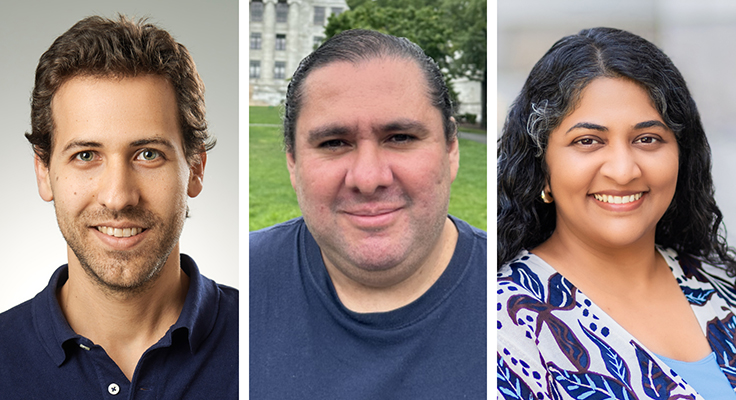
The Kenneth Rainin Foundation has announced that Dr. Ohad Lewin-Epstein, Dr. Gabriel Lozano Betancourt and Dr. Archana Venkataraman have been selected as the recipients of the Rainin Visionary Scientist Award. Each will receive a grant of $300,000 over two years to support their work, which has the potential to advance the understanding of Inflammatory Bowel Disease (IBD) and related biological systems.
The Rainin Visionary Scientist Award helps postdocs based in the US develop innovative research programs and strengthen their trajectory toward independent scientific careers. By supporting promising scientists early in their careers, the Rainin Foundation seeks to accelerate discoveries that may ultimately improve the lives of people living with Crohn’s disease and ulcerative colitis. New to the field of IBD research, both Dr. Lozano Betancourt and Dr. Venkataraman’s projects are grounded in basic science, while Dr. Lewin-Epstein’s project is translational.
The Rainin Visionary Scientist Awardees
Ohad Lewin-Epstein, PhD, Massachusetts General Hospital
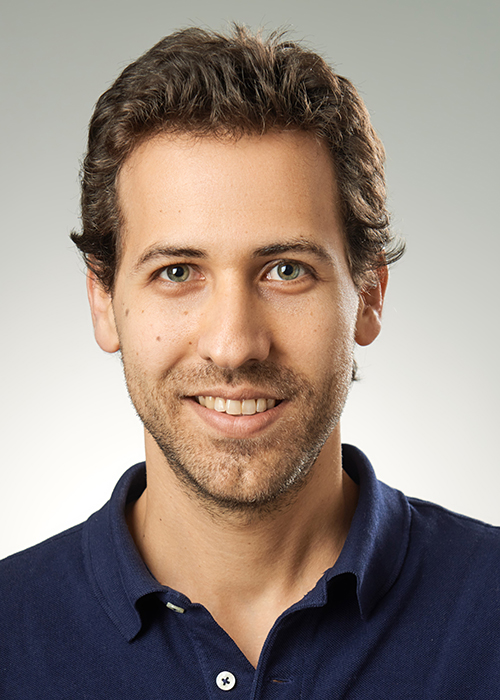
Dr. Lewin-Epstein’s research is driven by an interest in how evolution shapes microbial communities and host-microbiome interactions. He built an innovative approach to uncovering the microbial basis of autoimmune disease. His Rainin Visionary Scientist Award will support Decoding microbial adaptation to chronic intestinal inflammation to reveal disease mechanisms and predict disease trajectories in IBD.
Research Abstract: Chronic inflammation changes the gut environment, forcing bacteria to adapt. These adaptations are encoded in bacterial genomes, leaving lasting signatures of disease in the DNA of gut bacteria. The challenge is determining which of the millions of genetic changes are relevant to IBD. Dr. Lewin-Epstein built one of the largest microbiome datasets assembled to date, including samples from thousands of people with IBD and healthy individuals. Using this resource, he will identify adaptive signatures of IBD and use them to build a new class of evolution-informed models for earlier diagnosis, disease monitoring, prediction of future inflammatory flares and ultimately to improve patient outcomes.
Postdoctoral Independence: This work will establish a distinct research program at the intersection of microbial evolution and human disease, focused on understanding how disease environments shape microbial adaptation and how those evolutionary signatures can be translated into mechanisms, biomarkers and therapeutic opportunities.
I am grateful for the Rainin Foundation’s support, which will enable me to pursue new approaches to understanding host–microbiome interactions in IBD, with the potential to improve disease diagnosis and management. This award will also support my transition to an independent research career and help lay the foundation for my future research program.
Ohad Lewin-Epstein, PhD
Gabriel Lozano Betancourt, PhD, Boston Children’s Hospital

Dr. Lozano Betancourt’s recent work uncovered a link between diet, the microbiome and immunity: that gut bacteria can transform compounds found in plants into new molecules that regulate inflammation. His Rainin Visionary Scientist Award will support Harnessing food plant-derived bioactive molecules for IBD prevention and therapy.
Research Abstract: Both diet and the gut microbiome, the trillions of microorganisms that live in our intestines, have been strongly linked to IBD. However, it remains unclear how food, the microbiome and intestinal inflammation are connected. This project will identify dietary compounds that reduce intestinal inflammation, determine how gut bacteria convert these compounds into beneficial molecules and test whether beneficial bacteria can be used to generate these molecules in the gut. Ultimately, this work could lead to personalized dietary and microbiome-based therapies for IBD, in which foods and beneficial microbes are matched to an individual’s ability to generate protective molecules in the gut.
Postdoctoral Independence: This work will establish the foundation for Dr. Lozano Betancourt’s independent research program focused on understanding how diet–microbiome interactions shape inflammatory disease and developing scalable, mechanism-based therapies for IBD and other immune-mediated disorders.
IBD is a multifactorial disease, and to fully understand it, we need to study all of its components, not only the inflammatory response in the gut, but also the microbes that live there and the dietary compounds they encounter. I am grateful to the Rainin Foundation for supporting my research at the intersection of microbial metabolism, plant-derived dietary compounds, and the immune response, with the goal of better understanding IBD.
Gabriel Lozano Betancourt, PhD
Archana Venkataraman, PhD, University of California, San Francisco

Dr. Venkataraman’s work is driven by a central question: How do hormonal signals tune viscera-brain communication to shape stress and pain responses? Her Rainin Visionary Scientist Award will support Breaking down siloes of chronic pelvic pain.
Research Abstract: Pelvic pain is a common and debilitating symptom of IBD, irritable bowel syndrome and endometriosis, often complicating diagnosis and treatment. This project advances a new framework that positions the intestinal epithelium as a key driver of cross-organ pain signaling. Using cutting-edge tools to monitor epithelial signaling and visualize sensory nerve activity in real time, Dr. Venkataraman will identify the signals released by the gut after injury and determine how they alter pain pathways. She will also map the shared neural connections linking the colon and reproductive tract, revealing how inflammation in one organ can increase sensitivity in the other. By uncovering how hormones, inflammation and shared neural circuits interact, this work may reveal new strategies to prevent or treat chronic pain in IBD and other pelvic disorders.
Postdoctoral Independence: Dr. Venkataraman’s long-term goal is to establish an independent research program defining how hormone-dependent epithelial signaling reprograms sensory circuits to drive chronic visceral pain.
I’m interested in how gut inflammation, such as in IBD, affects sensitivity in the reproductive organs and vice versa, particularly the role hormones play in this crosstalk. This award will allow me to explore how these interactions drive pain that persists even after active inflammation has resolved. I’m especially thankful for this support as I work toward establishing my independent research program.
Archana Venkataraman, PhD
About The Kenneth Rainin Foundation
Kenneth Rainin Foundation is a family foundation that collaborates with creative thinkers in the Arts, Education and Health. We believe in taking smart risks to achieve breakthroughs. In 2024, the Foundation is celebrating 15 years of formal grantmaking that supports visionary artists in the Bay Area, creates opportunities for Oakland’s youngest learners and funds researchers on the forefront of scientific discoveries. Since 2009, the Foundation has awarded over $59 millionin funding to support innovative IBD research. Learn more about the Rainin Foundation’s grantmaking.