This blog is part of our series “Early Funding Paves the Way for Biomedical Innovation,” featuring conversations with leaders at three companies that are working on diagnostic or therapeutic solutions for people with Inflammatory Bowel Disease (IBD). These stories highlight how early-stage investments accelerated their novel ideas and how our ongoing partnership has supported their evolving work.
Below are highlights from our conversation with Steve Axelrod, PhD, President and CEO at G-Tech Medical, which has developed a non-invasive technology to monitor gut motility.
How do your innovations address gaps in managing and treating IBD?
Steve Axelrod, PhD: Our original idea at G-Tech Medical was to develop a user-friendly, easily accessible system to measure gut function via gastrointestinal motility. GutTracker® is a wearable patch that captures signals in the gut and connects wirelessly to the system that processes the signals. It could transform how doctors monitor changes in gut motility and how patients with gastrointestinal disorders understand their disease. Motility plays a major role in nearly all gastrointestinal disorders, either as the cause or a symptom, including post-op recovery.
Recently, we showed that motility of both the colon and small intestine are 20-30% lower in IBD patients who are in flare compared to those in remission. If we track patients longitudinally through routine monitoring, we could anticipate an impending flare before it becomes full blown. The ability to mail patch kits to patients to carry out the test remotely makes this a feasible and attractive alternative to regular clinic visits.
Why have you focused your work on IBD?
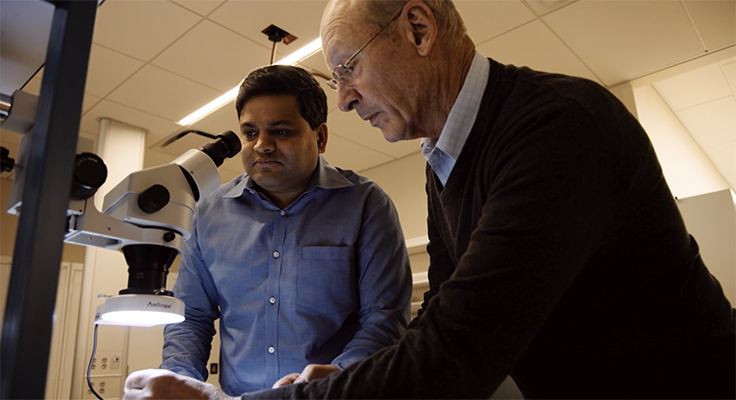
Steve: This is a personal mission. My mother died from colon cancer and my sister’s a survivor. Her daughters have gastrointestinal issues. And after my daughter, Lindsay, went through a frightening onset of Crohn’s disease and the search for an effective treatment, an opportunity at G-Tech popped up. Drawing on my background as an elementary particle physicist, my idea was to create a system that travels with patients as they experience life and their symptoms. I partnered with Dr. Anand Navalgund, a biomedical engineer and now G-Tech Medical’s Director of Clinical Science. His postdoc work focused on measuring electrical currents from skeletal muscles using similar techniques. Lindsay was one of our first subjects. She eventually earned a Master’s in Translational Medicine and is now our Clinical Science Program Manager. Her lived experience with the disease is central to our patients-first focus, informing our research questions, product design and clinical trial protocols.
What was the role of early funding in your product development?
Steve: In the startup world you’re constantly struggling to have enough funding to pay your employees. The Rainin Foundation’s support has been crucial to our early progress and continued existence. Our first grant in 2016 came through when we were very low on money. Our second grant in 2017 enabled us to progress in the data analysis code. Using longitudinal data from a study with Parkinson’s Institute, we discovered that each individual has a GutPrint, a long-term persistent signature that describes how their gut functions. It’s a reproducible measurement that supports personalized medicine.
In the startup world you’re constantly struggling to have enough funding to pay your employees. The Rainin Foundation’s support has been crucial to our early progress and continued existence.
How is the current landscape impacting your product development?
Steve: In the private sector, medical tech investors have pulled back on new investments. Many are focusing their attention and cash reserves on keeping their own portfolio solvent. We’ve benefited from this to some extent, but it has also made it hard to get the major new funding we need. In the public sector, a collaborator’s grant we were counting on had been fully approved but was clawed back by DOGE at the last hour.
What comes next in your development of this technology?
Steve: We’re raising funding to run a large pivotal style study for replacing gastric emptying scintigraphy, an existing test for patients with gastroparesis or functional dyspepsia. We’re also in talks with some large pharma companies that would like to use GutTracker® as an objective measure of efficacy of their IBD drugs if it can be proved effective in pilot studies. This opportunity is substantial. Knowing if a drug is doing what it was designed to do with a quantified measurement would eliminate the 35 to 40% placebo effect, and potentially get results in weeks rather than months. The baseline GutPrint might also inform decisions about the most effective drug for a given patient ahead of time. That would be worthy of a wow.
What message do you have for the field?
Steve: I don’t know what federal funding will look like a year from now but at the moment the situation in science and medicine research and even treatment is fraught. Private institutions that support innovative research are more critical than ever. To funders my request is to stay the course.
Private institutions that support innovative research are more critical than ever.